

The foundational architecture of personal transportation, built upon the century-old reliance on direct, continuous human control, is currently navigating an irreversible and profound technological revolution.
Historically, the burden of managing vehicle safety, navigation, and decision-making rested entirely on the biological and cognitive capacity of the human driver. This traditional model is inherently flawed, contributing to astronomical accident rates and significant traffic inefficiency globally.
Autonomous Driving technology, powered by sophisticated Artificial Intelligence (AI) and advanced sensor fusion, represents the indispensable, transformative solution to this systemic problem. AI systems are meticulously engineered to perceive the environment, predict the actions of other agents, and execute driving decisions faster and more reliably than any human could ever achieve.
This crucial discipline is far more than a simple driver convenience feature. It is a fundamental safety mechanism that promises to revolutionize urban planning, optimize commercial logistics, and drastically reduce the devastating incidence of road fatalities.
Understanding the defined levels of automation, the core sensor technology, and the necessary integration of AI is absolutely paramount. This knowledge is the key to comprehending the engine that drives the future trajectory of mobility and the entire automotive industry’s business model.
The Non-Negotiable Imperative of Automation
The strategic shift towards autonomous driving is primarily driven by the imperative to enhance safety and efficiency dramatically. Human error, stemming from fatigue, distraction, or impaired judgment, is the documented cause of the vast majority of all global road accidents. AI systems, operating with tireless vigilance, eliminate these pervasive human frailties entirely. This technological substitution is mandatory for achieving truly safe transportation networks.
Efficiency gains are a secondary but massive economic driver. Autonomous vehicles (AVs) can optimize routes collectively, maintain precise speed and following distances, and minimize unnecessary braking and acceleration. This optimized flow reduces traffic congestion. It also improves fuel efficiency significantly across the entire transportation network.
The economic value extends profoundly into the commercial logistics sector. Driverless trucks and autonomous delivery systems operate continuously, 24 hours a day, without mandated rest periods. This continuous operation maximizes asset utilization. It drastically reduces labor costs in the massive shipping and delivery industries.
The entire industry recognizes that Level 3 and Level 4 automation represent the critical commercial tipping points. These are the levels where the human driver can legitimately disengage from the driving task under specific conditions. This legal transition unlocks the true economic and social benefits of self-driving mobility. The technology must prove itself to be exponentially safer than human drivers.
Defining the Levels of Vehicle Autonomy
The industry utilizes a standardized framework, established by the Society of Automotive Engineers (SAE), to define six distinct levels of driving automation. This classification system clarifies the degree of human involvement required and the specific responsibilities of the driver and the system. The levels range from zero to five.
A. Level 2 (Partial Automation)
Level 2 (L2) represents Partial Driving Automation. The system can simultaneously control both the steering and the acceleration/deceleration under specific conditions. The human driver, however, must remain fully engaged and continuously monitor the driving environment. The driver must be ready to take over control instantly at any time. Systems like Tesla Autopilot or GM Super Cruise are commonly cited as L2 features.
B. Level 3 (Conditional Automation)
Level 3 (L3) represents Conditional Automation. The system manages all driving tasks under specific, limited operational design domains (ODDs), such as highway cruising or congested traffic jams. Crucially, the human driver is permitted to disengage their attention from the road. The system will issue a notice to the driver to take over control when the limits of the ODD are reached. The driver must be ready to regain control within a short transition period. L3 is the first level where true “hands-off” and “eyes-off” driving is legally permitted.
C. Level 4 (High Automation)
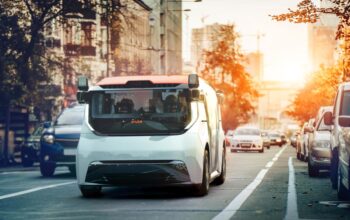
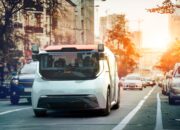
Level 4 (L4) represents High Automation. The vehicle manages all driving tasks autonomously within a defined ODD (e.g., a specific geo-fenced urban area or fixed campus route). If the system encounters a situation it cannot handle, it will safely pull itself over and come to a complete stop (a “minimal risk condition”). Human intervention is not required. L4 vehicles are now being deployed in commercial robotaxi services in limited cities.
D. Level 5 (Full Automation)
Level 5 (L5) represents Full Automation. The vehicle is designed to perform all driving tasks under every single road and environmental condition imaginable, without any human intervention whatsoever. The L5 vehicle would not even require a steering wheel or pedals. L5 is considered the ultimate, aspirational goal of autonomous technology. This full automation level does not yet exist commercially.
Sensor Fusion and AI Processing

The ability of an Autonomous Vehicle (AV) to safely perceive, predict, and react in the dynamic real world relies entirely on the complex integration of multiple sensor types and massive, real-time AI processing. No single sensor provides sufficient data integrity for safety. Sensor redundancy is mandatory.
E. Sensor Suite (Lidar, Radar, Cameras)
AVs utilize a sophisticated sensor suite. This suite includes Lidar (Light Detection and Ranging), which uses laser pulses to create detailed 3D maps of the environment. Radar uses radio waves to measure speed and distance, excelling in adverse weather. High-Resolution Cameras utilize computer vision to identify objects, pedestrians, and traffic signs. The combination of these three distinct sensor types ensures robust, redundant situational awareness.
F. Sensor Fusion
Sensor Fusion is the crucial AI process that combines the vast, disparate data streams from all the onboard sensors into a single, cohesive, highly reliable model of the external environment. AI algorithms continuously weigh the inputs, compensating for the limitations of any single sensor (e.g., Lidar’s poor performance in fog, camera’s difficulty in extreme darkness). This integrated model is necessary for decision-making.
G. AI and Machine Learning
Artificial Intelligence and Machine Learning (ML) are the intelligence engines of autonomy. ML models are trained on billions of miles of real-world driving data. This massive training enables the AI to accurately predict the trajectory and behavior of other road users (pedestrians, cyclists, other vehicles). This predictive capability is essential for safe navigation.
H. Vehicle-to-Everything (V2X) Communication
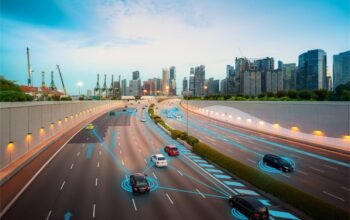
Vehicle-to-Everything (V2X) communication is the indispensable connectivity layer. V2X allows the AV to exchange real-time safety, traffic, and environmental data instantly with other vehicles (V2V) and with surrounding infrastructure (V2I). This information exchange expands the vehicle’s situational awareness far beyond the range of its immediate onboard sensors. V2X significantly enhances collective road safety and traffic flow.
Regulation, Ethics, and Deployment
The widespread deployment of Autonomous Vehicles requires navigating complex regulatory frameworks, ethical dilemmas, and severe public acceptance hurdles. The legal and social structure must adapt to the new reality of machine drivers. Public confidence is mandatory for adoption.
I. Regulatory Frameworks
Governments are actively developing regulatory frameworks to define liability in the event of an accident involving a machine driver. Laws must establish clear, verifiable standards for AV safety testing and deployment within specific operational domains (ODDs). Regulatory clarity is essential for accelerating technological development and securing public permission for deployment.
J. Cybersecurity Risk
The software-defined nature of AVs introduces immense cybersecurity risk. AVs must be protected from malicious hacking that could remotely seize control of the vehicle or compromise its sensor data. Robust, multi-layered cybersecurity protocols and continuous over-the-air (OTA) software patching are non-negotiable requirements for safety. The software must be resilient against external attack.
K. The Ethical Dilemma (The Trolley Problem)
AV programming must address severe ethical dilemmas. The most famous is the “Trolley Problem,” which requires programming a choice between two bad outcomes. The AV’s decision-making algorithms must incorporate explicit, auditable moral and ethical frameworks. These frameworks guide necessary trade-offs in unavoidable accident scenarios. The ethical programming is subject to intense public and legal scrutiny.
L. Public Acceptance and Trust
The speed of deployment is ultimately constrained by public acceptance and trust. Consumers must be convinced that the machine driver is statistically and verifiably safer than a human driver. Manufacturers must maintain radical transparency regarding the system’s capabilities, limitations, and failure protocols. Building public confidence through flawless operational track records is the long-term goal.
Conclusion

Autonomous Driving is the essential technological revolution eliminating human error from the act of transportation.
The core goal is the achievement of Level 3 and Level 4 automation, which permits the driver to disengage from the critical driving task.
Safety is guaranteed by the complex integration of redundant sensors, including Lidar, Radar, and high-resolution cameras, into a single model.
AI and Machine Learning are the intelligence engines that predict the behavior of other agents and execute crucial driving decisions in real-time.
Ultra-low latency 5G networking and V2X communication expand the vehicle’s situational awareness far beyond the limits of its onboard sensors.
The economic imperative is the massive reduction in commercial logistics costs by enabling 24/7, continuous operation of driverless transport fleets.
Regulatory clarity and the development of auditable ethical programming standards are mandatory for securing public permission for widespread deployment.
Cybersecurity defense is non-negotiable, requiring continuous OTA updates and multi-layered protocols to protect the vehicle’s critical control software.
The transition to autonomous vehicles will fundamentally reshape urban planning by allowing for the reallocation of space previously dedicated to parking and roads.
This technology promises a profound societal benefit by drastically reducing the devastating incidence of road fatalities caused by human error.
Autonomous Driving stands as the final, authoritative guarantor of efficiency, safety, and productivity in the future of global mobility.
Mastering this complex blend of AI, engineering, and data science is the ultimate key to achieving the next major phase of human transportation.